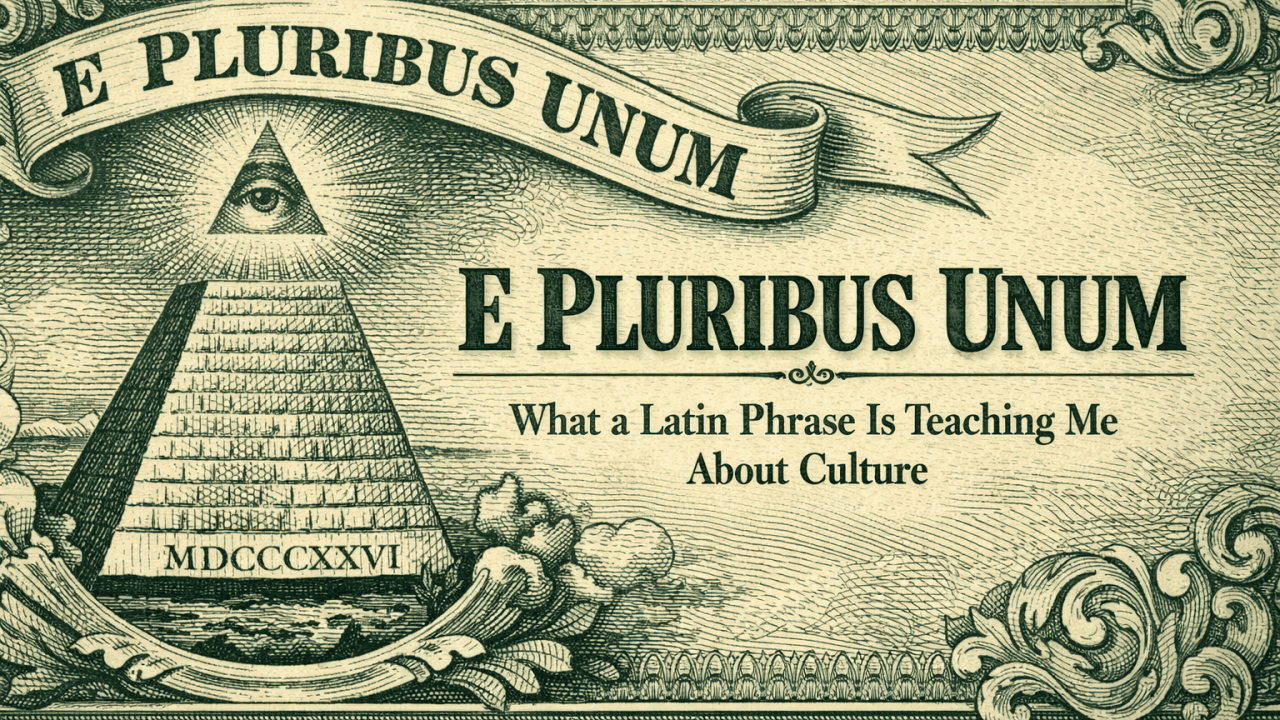
The original idea was not that the many would disappear. It was that many distinct colonies, cultures, and identities could voluntarily align around a purpose larger than themselves. Unity was not meant to erase differences — it was meant to give differences a shared direction.
The original idea was not that the many would disappear. It was that many distinct colonies, cultures, and identities could voluntarily align around a purpose larger than themselves. Unity was not meant to erase differences — it was meant to give differences a shared direction.
My son was recently telling me about a television series he has been watching. In the story, humanity becomes fused into a single, peaceful, cooperative collective. No conflict. No lying. No loneliness. But also no individuality. A modern version of the Star Trek Borg, for those who remember. In the television series, a few people remain outside this "joining" collective, unsettled by what that kind of unity costs.
It made me think of a Latin phrase I have seen my whole life on U.S. currency:
E pluribus unum.
I have always known what the phrase translates to, but I realized I had never really sat with what it was trying to solve.
The original idea, in the forming of the United States, was not that the many would disappear. It was that many distinct colonies, cultures, and identities could voluntarily align around a purpose and outcome larger than themselves. Unity was not meant to erase differences. It was meant to give differences a shared direction.
Today, it often feels like we have no shortage of "pluribus." We are very good at protecting identity, history, and individual points of view. What feels harder to sustain is "unum," a shared story about what we actually stand for. Without that, people naturally retreat into tribes. That is not a political statement. It is a human one.
I see the same dynamic everywhere in my work. In my career, I have the privilege of working with large institutions: hospital clusters, university systems, conglomerates, and global enterprises. These organizations are rarely one homogeneous "thing." They are made up of proud, distinct institutions that existed long before most of their current employees arrived.
People do not just join these organizations. They inherit them. They absorb their histories, their heroes, their rivalries, and their sense of who "we" are.
Think about how attached many of us are to our universities or sports teams. We did nothing to create their past, yet we feel loyalty, pride, and sometimes even rivalry as if it were personal. Organizational cultures work the same way.
So when a multi-institutional enterprise tries to become more aligned, the tension is not really about processes or structures. It is about meaning.
When leaders make purpose explicit, clarify what success really means, and define how people are expected to behave with one another, they are doing something very powerful. They are offering a larger story that sits above local stories, and that raises a quiet, emotional question for every part of the system:
Is this story allowed to be more important than mine?
This is why culture work so often feels charged. It is not really about leaders controlling behavior. It is about people aligning around what they treat as meaningful.
This is where E pluribus unum becomes surprisingly relevant.
In healthy systems, "one" does not mean uniform. It means federated.
A federated system is made up of distinct parts that keep their own identity but are bound together by a shared center. Each part retains its history, pride, and character, while all agree to operate under a common purpose, a common standard of excellence, and a shared set of commitments and behaviors.
That is very different from forcing everyone to be the same. And it is very different from letting everyone do their own thing.
It is many, without chaos. One, without erasure.
Or put more simply:
You do not have to stop being who you are to belong to something larger than yourself.
That, to me, is what E pluribus unum was always pointing to. And it may be one of the most important ideas we keep having to rediscover, whether we are talking about nations, organizations, or ourselves.
The essential insights from this article.
Unity was not meant to erase differences — it was meant to give differences a shared direction
Culture work feels charged because it is about people aligning around what they treat as meaningful
In healthy systems, 'one' does not mean uniform — it means federated: distinct parts bound by a shared center
You do not have to stop being who you are to belong to something larger than yourself
Explore more insights on leadership, transformation, and organizational effectiveness. Each piece is designed to challenge your thinking and provide practical frameworks for navigating complexity.
