
Most culture transformations feel heavy at the beginning. Like something large that refuses to move. There is visible effort, public endorsement, and structured cadence — and still, progress feels slower than expected. Many leaders assume something is wrong. It isn't. It's physics.
Most culture transformations feel heavy at the beginning. Like something large that refuses to move. There is visible effort, public endorsement, and structured cadence — and still, progress feels slower than expected. Many leaders assume something is wrong. It isn't. It's physics.
Most culture transformations feel heavy at the beginning. Like something large that refuses to move.
Leadership commits to change. Workshops roll out. New language appears. Expectations are clarified. Coaching begins.
There is visible effort. Public endorsement. Structured cadence.
And still, progress feels slower than expected.
Many leaders assume something is wrong.
It isn't.
It's physics.
Physics offers a simple way to understand why culture change feels so heavy at the beginning.
Newton's Second Law explains the first phase:
F = ma
Force = Mass × Acceleration
The larger the system (mass), the more force required to accelerate it.
Large organizations have enormous structural mass: norms, incentives, reporting lines, decision rights, and historical success patterns. Moving that system requires visible effort.
That is why the early phase of culture transformation always feels heavy.
But force alone does not explain what happens next.
Physics also explains momentum.
p = mv
Momentum = Mass × Velocity
Once velocity exists, momentum exists. And momentum does not require constant force to continue. It persists unless acted upon by an opposing force.
Organizations work the same way.
Early effort creates motion. But lasting progress only emerges when the system itself begins to carry that motion forward.
There is a point when that shift occurs.
A dividing line where culture stops depending on pressure and begins sustaining itself through reinforcement.
That moment is what I call the Momentum Threshold™.
All large systems have inertia.
Established norms, legacy incentives, power structures, and familiar decision patterns create equilibrium, a state of stability the system naturally protects.
And disrupting that stability requires force.
Every culture transformation begins here.
Motion is introduced into a stable system. Leaders push. Energy is applied. Attention intensifies.
Force is necessary.
But it is not sustainable.
If culture requires continuous prompting from sponsors, reinforcement from HR, consultant facilitation, and CEO reminders simply to maintain engagement, the organization has not yet crossed the Momentum Threshold™.
When senior leaders delegate their own engagement, they send a signal. Culture always follows the loudest signal in the room.
If leaders talk about culture but do not change how they make decisions, what they reward, or what they tolerate, the underlying reinforcement system remains intact.
In that case, language shifts. Behavior does not.
Hiring decisions remain the same. Promotion criteria remain the same. High performers who violate standards remain protected. Consequences remain uneven.
And when reinforcement does not change, momentum never forms.
Systems reorganize around what is rewarded and what is corrected, not around what is announced.
That reorganization is the dividing line.
The Momentum Threshold™ is crossed when culture reinforcement architecture reduces organizational friction and the system begins sustaining motion on its own.
It is the point where reinforcement carries motion without continued executive pressure.
Until that threshold is crossed, culture remains dependent on pressure.
And remaining dependent on pressure carries real risk.
When pressure continues without structural conversion, fatigue sets in. Fatigue becomes skepticism. Skepticism hardens into cynicism.
Leaders invest time, credibility, and real budget in the effort.
But if reinforcement does not change, behavior does not change. Over time, the question shifts from belief to return on investment.
And the cost does not stop with culture.
The next major initiative, whether operational excellence or another transformation effort, begins under a cloud.
The organization remembers how past pushes ended.
When reinforcement never shifts, the organization learns that effort is temporary and gravity eventually wins.
That memory increases the force required the next time.
Momentum in culture change is not accidental. It is engineered through culture reinforcement architecture.
Understanding where your organization sits on the continuum from inertia to momentum is not philosophical. It is structural.
Culture change tends to move through a predictable sequence of stages. Each stage reflects how motion is sustained within the organizational system.
I refer to this sequence as The Culture Momentum Model™.
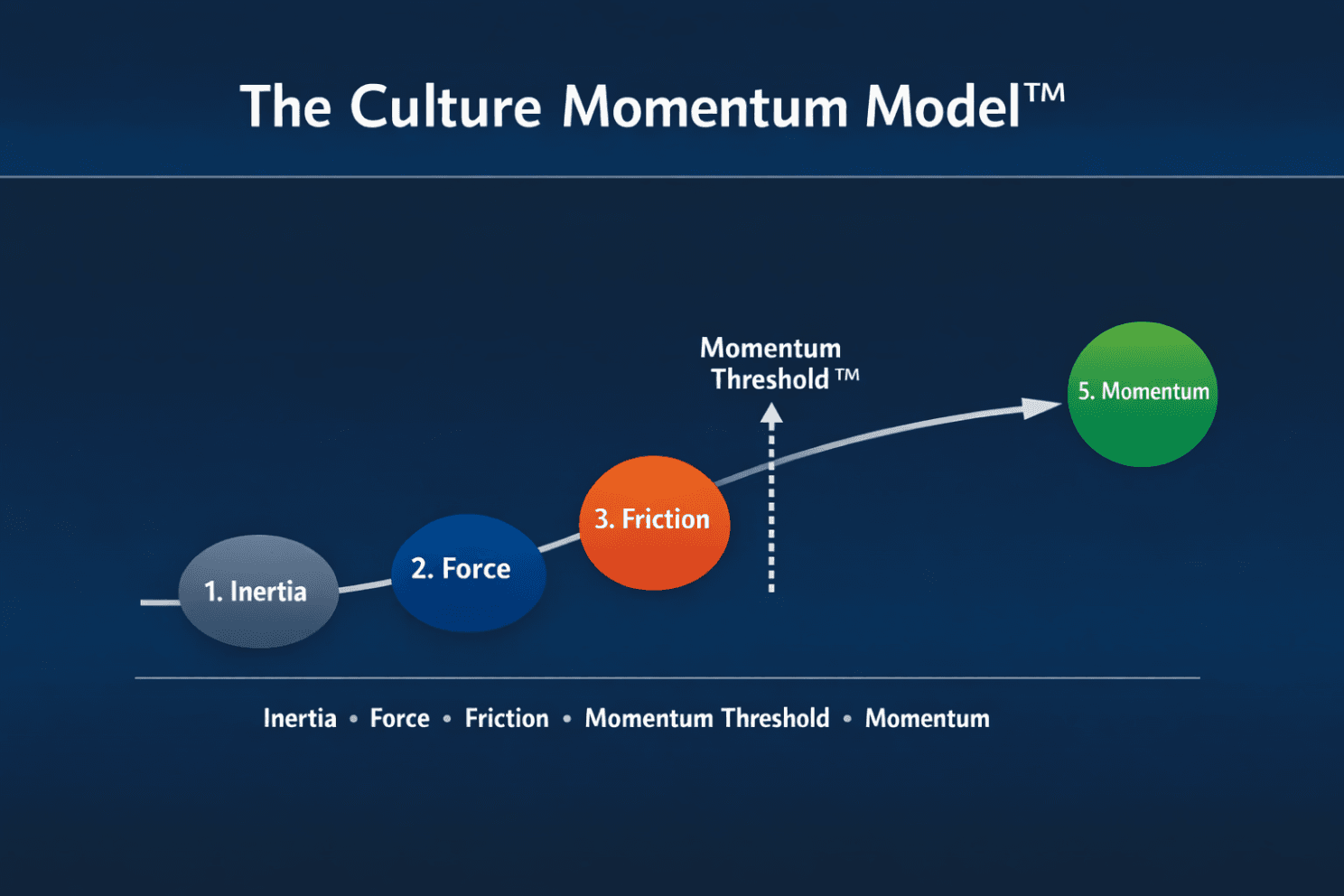
The Culture Momentum Model™: The stages organizations move through as culture shifts from inertia to sustained momentum.
Each phase represents a different way motion is sustained inside the system:
Understanding where your organization sits on this continuum is not philosophical.
It's structural.
Inertia is stability.
Norms are embedded. Incentives are patterned. Decision rights are established. Leaders know what is rewarded and what is tolerated.
Results may even be strong.
But reinforcement loops protect the status quo.
If collaboration is stated but individual output is rewarded, individual output wins.
If accountability is encouraged but conflict is avoided, avoidance persists.
If standards are declared but violations are tolerated for high performers, the system learns what truly matters.
Nothing appears broken. But nothing meaningfully shifts.
Movement is minimal because the underlying architecture has not changed.
Force begins when leaders decide the current state is no longer sufficient. A new language is introduced. Standards are clarified. Workshops and coaching are launched. Direction is clearly signaled from the top.
The organization begins to move.
But it is moving because energy is being applied. Sponsors reinforce the message. HR tracks follow-through. Consultants facilitate sessions. Leaders remind their teams of expectations. Progress is sustained by visible pressure.
There is activity. Conversations shift. Engagement appears real.
Yet beneath the surface, the reinforcement system often remains unchanged. Performance is still measured as it was before. Promotions continue to reward the same strengths. High performers are still protected even when they violate declared standards.
Leaders see movement and assume momentum.
But motion sustained by pressure is not momentum. It is repeated force.
When the pressure lifts, the system drifts back toward equilibrium.
Force can create acceleration. But acceleration is not momentum. Momentum begins only when the system itself carries the motion.
Force can create acceleration. It cannot create durability.
This is where many culture transformations stall.
In physics, motion encounters friction. Energy is applied, but opposing forces slow the system down.
Organizations behave the same way.
Even when leaders apply force, underlying reinforcement systems often remain unchanged.
Performance reviews still reward the same behaviors. Promotion decisions still prioritize technical output over leadership standards. High performers who violate culture expectations remain protected.
The system sends mixed signals.
Decades ago, organizational psychologist Kurt Lewin described this dynamic in his Force Field Model. Change occurs when driving forces exceed restraining forces inside the system.
Culture transformations often increase the driving forces without addressing the restraining ones.
In physics, acceleration occurs only when applied force exceeds friction.
In organizations, progress occurs only when reinforcement begins to align with declared standards.
Until that alignment occurs, energy must be continuously applied just to maintain motion.
That is why culture initiatives often feel exhausting.
Leaders push harder. Communication increases. Training expands. Reminders multiply.
But friction remains.
And when pressure eventually lifts, the system slows and drifts back toward equilibrium.
This is not failure. It is merely friction.
Friction disappears only when the culture system itself is redesigned.
In physics, motion accelerates only when the total force acting on an object exceeds the forces resisting it.
Engineers describe this as net force.
Net Force = Applied Force − Friction
Organizations behave the same way.
Leaders often respond to slow progress by increasing pressure. More communication. More initiatives. More reminders.
But when organizational friction remains unchanged, additional effort produces little movement. Misaligned incentives persist. High performers remain protected despite behavioral misalignment. Promotion signals contradict declared standards.
The system absorbs the force.
Progress accelerates only when friction begins to fall and the net force acting on the organization becomes positive.
When that happens, the system approaches the Momentum Threshold™. And once that threshold is crossed, momentum emerges.
Momentum begins when the culture reinforcement architecture changes.
Culture is no longer sustained by reminders. It is sustained by design. What gets rewarded, corrected, promoted, and protected now reflects the declared standards.
Leaders are accountable not only for results, but for how results are achieved. Misalignment is addressed consistently, not selectively.
Ownership is no longer concentrated in a sponsor or transformation team. It lives across the leadership system.
At this stage, progress does not depend on pressure. It continues because the structure supports it.
What once required force now moves with flow.
Momentum does not create utopia. Dysfunction still appears. People are still imperfect.
The difference is this: correction becomes predictable.
In a force-driven culture, correction depends on personality, hierarchy, or who is watching. In a momentum culture, correction happens because the system requires it.
That is the shift.
Many organizations confuse motion with momentum. Awareness creates motion. Reinforcement creates durability.
Which phase describes your organization today?
Inertia. Force. Friction. Or Momentum.
Crossing the Momentum Threshold™ is not about working harder.
It is about changing what the system reinforces.
When progress slows, most leaders respond the same way. They add effort. More communication. More sessions. More reminders.
But pressure applied to an unchanged structure only produces temporary motion.
If reinforcement does not change, the system will eventually return to its prior pattern.
To cross the threshold, five operational shifts must occur:
1. Standards Are Corrected in the Room. Real-time correction signals that the standard matters. Silence protects the old culture.
2. Promotion Signals the Real Rules. When promotions reflect both results and standards, the culture signal becomes unmistakable.
3. Leaders Hold the Line When It Costs Something. Culture becomes real when leaders protect the standard even when the person involved is a high performer.
4. Accountability Moves Sideways. Momentum begins when peers hold peers accountable without waiting for hierarchy.
5. Systems Reinforce the Standard. When hiring, promotion, and performance reviews reflect declared culture, the organization begins carrying the motion itself.
When these shifts occur, something subtle happens.
Reminders become less necessary. Follow-through becomes more consistent. Standards are protected without escalation.
There is no announcement. No ceremony.
Force has done its job.
Structure now carries the work.
If sustained progress still depends on pushing and reminding, the issue is not commitment.
It is design.
Culture momentum begins when correction no longer depends on the boss.
The essential insights from this article.
Physics explains why culture change feels heavy — large organizations have enormous structural mass, and Newton's Second Law (F=ma) shows why the early phase always requires visible force
The Momentum Threshold™ is crossed when culture reinforcement architecture reduces organizational friction and the system begins sustaining motion on its own — without continued executive pressure
Organizations move through four phases: Inertia (stability protected by reinforcement loops), Force (energy applied to initiate motion), Friction (resistance from misaligned reinforcement), and Momentum (progress carried by structural design)
Five operational shifts are required to cross the threshold: standards corrected in the room, promotion signals the real rules, leaders hold the line when it costs something, accountability moves sideways, and systems reinforce the standard
Explore more insights on leadership, transformation, and organizational effectiveness. Each piece is designed to challenge your thinking and provide practical frameworks for navigating complexity.
