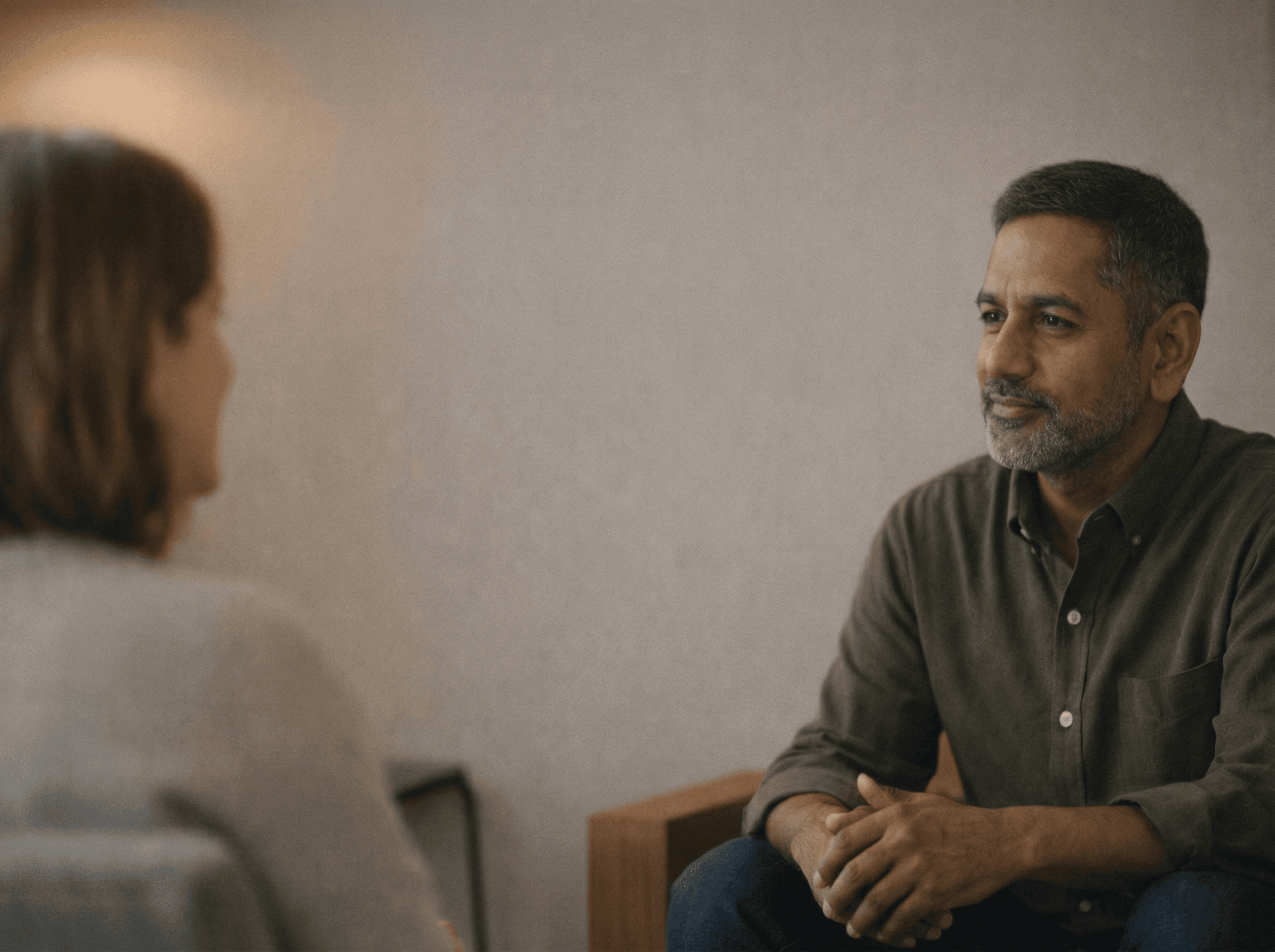
What determines whether coaching genuinely helps or subtly harms is not the brilliance of the coach's question or the rigor of a certification. It's the state of presence in which the conversation happens.
What determines whether coaching genuinely helps or subtly harms is not the brilliance of the coach's question or the rigor of a certification. It's the state of presence in which the conversation happens.
A practitioner's reflection on what actually reduces suffering
I've hesitated to write this.
Not because I doubt the ideas, but because writing about coaching philosophies can easily slide into promotion or certainty that feels cleaner on paper than it does in real human conversations.
That's not my intent.
What follows is a practitioner's reflection shaped by years of formal coaching training, ongoing practice, and sustained study across leadership, psychology, neuroscience, trauma, consciousness, and spiritual traditions.
It has been refined through missteps, personal contemplative and therapeutic work, and by sitting with people when the stakes were real, while learning from clinicians whose domains I respect but do not claim.
That's worth saying plainly.
Traditional coaching has helped millions of people clarify goals, improve performance, strengthen leadership capacity, and navigate complex professional transitions. Entire industries and certification bodies exist because the practice delivers value.
I've benefited from that training myself. It gave me structure, discipline, and a foundation I still rely on.
And.
Over time, something else became increasingly clear.
What determines whether coaching genuinely helps or subtly harms is not the brilliance of the coach's question, the elegance of a coaching model, or the rigor of a certification.
It's the state of presence in which the conversation happens.
Most certified coaching methodologies assume something implicitly:
That the client is sufficiently regulated, resourced, and psychologically safe to access insight and act on it.
Often, that assumption holds.
But often — especially with senior leaders, caregivers, founders, physicians, executives, and people under sustained pressure — it does not.
In those moments, clients don't lack intelligence, motivation, or accountability.
They lack nervous system safety.
When safety is missing:
This isn't a critique of coaching.
It's a recognition that a method designed for one internal state may not serve another.
Over time, my work has shifted away from prioritizing performance first and toward relieving unnecessary suffering first.
By "performance," I don't just mean results. I also mean something subtler and common in our profession: the way coaches themselves can begin to perform.
Performing competence.
Performing insight.
Performing relevance or value in the room.
When that happens, often without awareness, attention moves away from the client's internal state and toward delivering something impressive or useful.
The session may look productive, yet quietly add pressure.
What changed for me was not abandoning outcomes, but changing the entry point.
Again and again, I've seen this pattern:
When awareness and safety increase, suffering decreases. When suffering decreases, clarity and responsibility return.
And when clarity and responsibility return, people make cleaner decisions, set healthier boundaries, and take action they can actually sustain.
Presence is not being "in the moment," tone, likability, or warmth alone.
It is also not agreement, avoidance, or emotional cushioning.
Presence is the capacity to stay grounded, attentive, and non-defensive while reality is allowed to surface, including discomfort, emotion, and truth.
In that state, people regain access to their own judgment. They can see more clearly, discern what matters, and take responsibility without self-attack.
That is where wisdom shows up in practice.
If you're curious how this orientation changes coaching in the room, here are two small experiments that require no new models or tools.
1. Regulate before you inquire
Before asking your next "good" question, pause for a few seconds and check your own internal state.
Do nothing to the client yet.
Let your body slow first.
Often, when regulation returns, the right question changes or becomes unnecessary.
2. Track safety, not just insight
As the conversation unfolds, notice less what the client is saying and more how their system is responding.
If safety drops, don't push insight forward.
Slow the conversation instead.
Clarity emerges far more reliably from safety than from pressure.
The approach I now practice, which I refer to as Presence-Based Compassionate Coaching, is not a rejection of traditional coaching.
It is a re-ordering of priorities.
Many coaching conversations implicitly follow this sequence:
Insight → Action → Results
This approach starts earlier:
Presence & Regulation → Awareness → Sustainable Action
Same destination.
Different starting point.
When presence and regulation are established:
When they are not, technique alone rarely compensates.
That distinction matters.
Presence-based compassionate coaching is not about:
In practice, it often produces stronger accountability, because action is no longer driven by fear or self-protection.
It comes from clarity.
I'm not writing this to sell a method or build a brand.
If my purpose is the relief of human suffering, then it would be inconsistent to withhold an approach that appears to reduce it simply to protect ownership or positioning.
The world does not need fewer coaches.
It needs more regulated, present, and compassionate ones.
If this perspective sharpens how you practice, train, lead, or coach, take what's useful. Adapt it. Let it evolve.
Ideas don't heal people.
People, in presence with one another, do.
And when that presence is practiced without performance, its impact travels far beyond any single name attached to it.
The essential insights from this article.
What determines whether coaching helps or harms is the state of presence in which the conversation happens
When clients lack nervous system safety, even well-intended coaching can increase strain
When awareness and safety increase, suffering decreases; when suffering decreases, clarity and responsibility return
Presence-Based Compassionate Coaching re-orders priorities: Presence & Regulation → Awareness → Sustainable Action
Explore more insights on leadership, transformation, and organizational effectiveness. Each piece is designed to challenge your thinking and provide practical frameworks for navigating complexity.
