
From Emperor's Palace to People's City
Diocletian's Palace transformed by the people.
From Emperor's Palace to People's City
Diocletian's Palace transformed by the people.
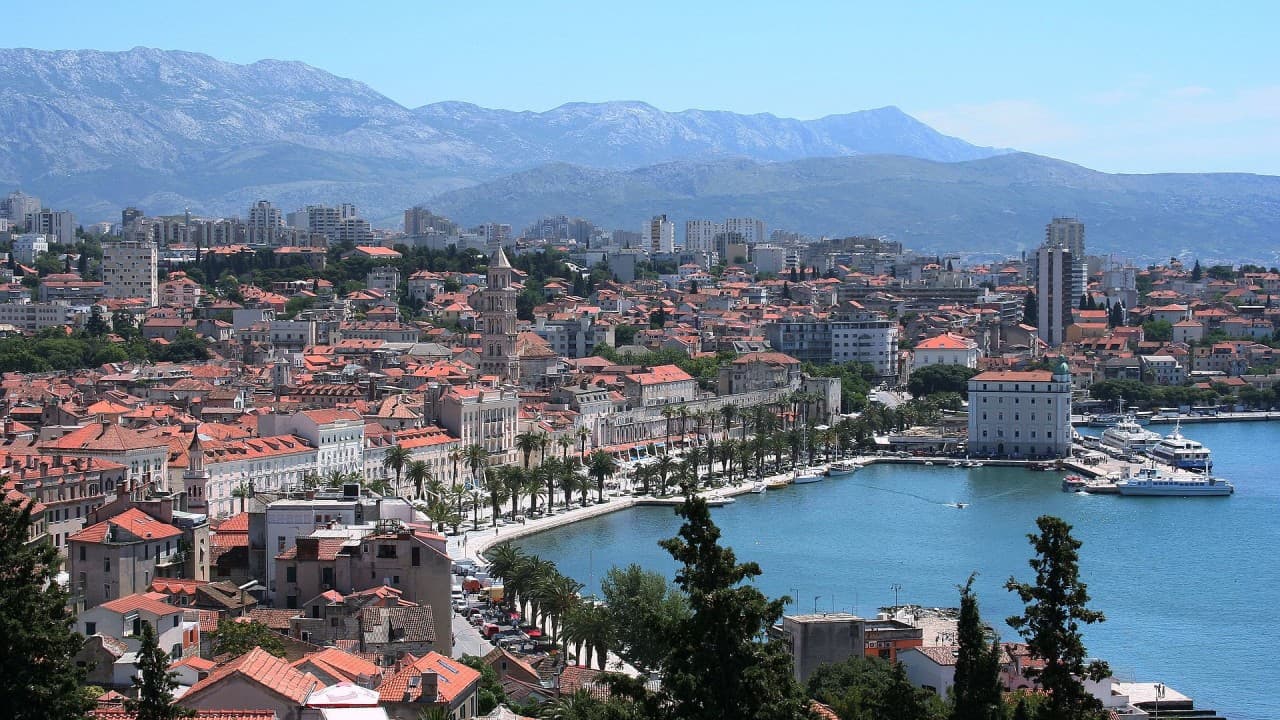
I'll admit this one wasn't easy to write. On arrival, Split, Croatia looked like a city pressed between the Adriatic Sea and a ridge of grey mountains, its old town literally tucked inside the walls of Diocletian's Palace. As we drove in, modern apartment blocks and industrial docks quickly gave way to narrow lanes and ancient stone walls. My first impressions hinted at how different Split would be. Unlike Kraków, Budapest, or Vienna, the leadership lessons of this city aren't as clear cut. Vienna alone could have filled ten different articles with its emperors, musicians, and visionaries. But Split? Its story isn't carried by a single, towering leader. There are no obvious names to hold up as paragons of conscience or courage.
To write this, I had to search harder. I had to study, research, and look beneath the surface. And what I found is a city whose leadership story is not about one person, but about the paradox of an emperor — and the resilience of a people who transformed his palace into their home.
The Emperor Who Let Go
Diocletian was born around 244 AD near the town of Salona, on the Dalmatian coast. Far from the grandeur of Rome, his origins were humble — the son of a provincial family with no claim to nobility. (And yes, fun fact: the spotted Dalmatian dog breed also takes its name from this same region, where it was historically associated and recorded.)
From these coastal beginnings, Diocletian rose through the ranks of the Roman army, proving himself a capable soldier and commander. In 284 AD, after the assassination of Emperor Numerian, he was proclaimed emperor by his troops. From the edge of empire, he had climbed all the way to its summit.
But imagine the mindset of Rome at that moment. After the death of Marcus Aurelius in 180 AD — the philosopher-emperor remembered for his writings on Stoicism — Rome began a long slide into chaos. Marcus Aurelius's reign of 19 years had been the last stretch of relative stability. What followed was over a century of upheaval: Commodus's erratic rule, a string of short-lived emperors, and finally the Crisis of the Third Century (235–284 AD), when nearly fifty emperors rose and fell in less than fifty years, most assassinated or overthrown.
By the time Diocletian rose to power in 284 AD, trust in leadership was shattered. The very structures of politics, commerce, and daily life had adjusted to instability. And into that chaos stepped Diocletian.
Once in power, he faced a world unraveling: invasions from without, assassinations from within, economic collapse, and civil war. Through sweeping reforms, he stabilized Rome: dividing the empire into East and West, creating the Tetrarchy (rule of four), and reorganizing its armies and provinces. He was a systems-builder who saved an empire.
Yet his legacy is conflicted. Diocletian also unleashed the fiercest persecution of Christians in Roman history. Churches were destroyed, believers martyred, faith driven underground.
And then came the paradox. At the height of power, Diocletian did what no Roman emperor had ever done: he stepped down. Ancient sources record that by 304 AD he was gravely ill, weakened after two decades of holding an empire together. But his abdication in 305 AD wasn't only about health. It was also a validation of the Tetrarchy — the very system he had created so that Rome would not depend on one man. His departure proved his system could carry on without him.
That choice is striking when compared with leaders in every age who struggle to let go. We've all seen professional athletes who keep playing well past their prime, a shadow of what they once were. Or television shows that "jump the shark" — dragging on until their spark is gone. One of the most famous counter-examples is the American sitcom Seinfeld, which dominated television in the 1990s and ended in 1998 while still the #1 show in the United States. Jerry Seinfeld himself explained that he wanted the ending to be graceful. In the same way, Diocletian stepped away from power — retiring to Split to work his gardens rather than fight to keep a throne he could no longer hold.
The People Who Transformed the Palace
But Split's real story came after Diocletian. In the early 7th century, the nearby city of Salona — Diocletian's own birthplace and once the capital of Roman Dalmatia — was destroyed by invading Avars and Slavs. Its walls fell, its population scattered, and the survivors fled in search of refuge. Only a few kilometers away, they found it: inside the abandoned shell of Diocletian's palace.
There, behind its massive stone walls, they fortified themselves against further attack. What had once been an emperor's fortress now became a people's shield. And with no emperor to guide them, the people themselves had to take accountability for their fate. Leadership came not from a single throne, but from captains on the ground — neighbors organizing, coordinating, and defending together.
It's a powerful reminder for today's organizations. Even in companies with strong hierarchies or high power-distance structures, employees often have more agency than they realize. They don't have to wait for the CEO to solve everything. Cultures are built day by day through the accountability of people who step up, take ownership, and shape outcomes together.
The greatest twist? Diocletian's mausoleum — built as his eternal monument — was turned into a Christian cathedral dedicated to St. Domnius, a bishop Diocletian himself had executed.
Walking through Split today, you see the irony carved in stone. The emperor who tried to erase a faith now lies overshadowed by it. His palace still stands, but its meaning was rewritten by those who lived within its walls.
For leaders, the lesson is not that your work doesn't matter — it's that your true legacy is shared. You can design systems, set direction, and build structures. But over time, it is the people — their choices, their accountability, their culture — who give lasting meaning to what you leave behind. What begins as a fortress of power can, in the hands of a resilient people, become a cathedral of hope.