
Schindler's Awakening
Where the journey began with Schindler's awakening.
Schindler's Awakening
Where the journey began with Schindler's awakening.
Walking through the cobblestone streets of Kraków's Kazimierz district, you can still feel the echoes of a thousand stories. The weight of history presses down on these ancient stones-stories of joy and tragedy, of ordinary people caught in extraordinary circumstances, and of one man whose awakening would save over 1,200 lives.
Oskar Schindler was not a saint. He was a womanizer, a drinker, a gambler, and an opportunist who joined the Nazi party to advance his business interests. Yet somewhere in the darkness of the Holocaust, something shifted within him. His story is not just one of heroism-it's a testament to the power of moral awakening, and a reminder that leadership often emerges from the most unlikely places.
The Moment of Choice
Every leader faces moments where the easy path diverges from the right path. For Schindler, that moment came gradually, then all at once. As he witnessed the liquidation of the Kraków ghetto from his horse on a hillside, watching a little girl in a red coat wander through the chaos, something broke open inside him.
He had come to Poland to make money. He had hired Jewish workers because they were cheap labor. But somewhere along the way, they stopped being assets on a balance sheet and became human beings-people with names, families, dreams, and an inalienable right to exist.
What followed was a masterclass in subversive leadership. Schindler used his charm, his connections, and his wealth to protect "his" Jews. He bribed Nazi officials, falsified documents, and transformed his factory into a sanctuary. He risked his fortune and his life, not for profit, but for principle.
Leadership as Stewardship
In our modern context, while the stakes may not be life and death in the same way, the principle remains: true leadership is about stewardship. It is about using whatever power and privilege we have to protect and uplift those under our care.
Schindler's transformation challenges our assumptions about who can be a leader. He wasn't perfect. He didn't start out noble. But when it mattered most, he chose to see the humanity in others when the world was trying to strip it away.
This is the essence of moral leadership: the willingness to risk comfort, safety, and status for the sake of doing what is right. It's about recognizing that our choices ripple outward in ways we cannot always predict or measure.
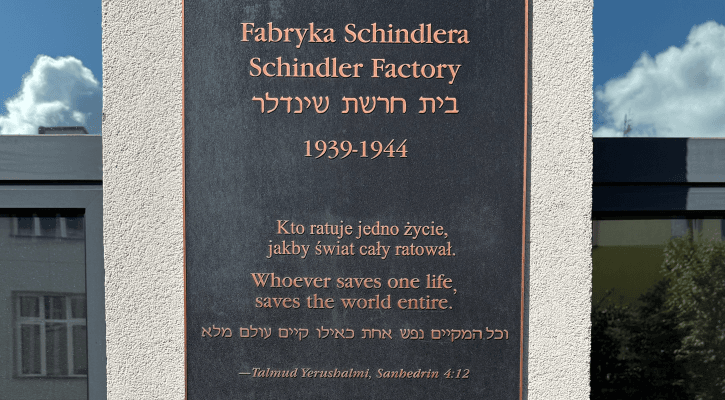
""He who saves one life, saves the world entire."
This Talmudic saying, inscribed on the ring given to Schindler by the workers he saved, captures something profound about the nature of impact. We often measure leadership in metrics-revenue, growth, market share. But the truest measure of a leader's worth is found in the lives they touch and the dignity they preserve.
The Cost of Awakening
By the end of the war, Schindler was broke. He had spent his entire fortune on bribes and black market goods to keep his workers alive. When the war ended, he had to flee, hunted as a Nazi collaborator. He died in poverty, largely forgotten.
But his legacy lives on in the thousands of descendants of the Schindlerjuden-Schindler's Jews. Today, there are estimated to be over 8,500 descendants of the people he saved. Entire family trees exist because one flawed man chose to awaken to his moral responsibility.
Standing in Kraków, visiting the factory that became a sanctuary, you realize that leadership is not about perfection. It's about the courage to change, to grow, to see beyond yourself. It's about the moment when you stop asking "What can I gain?" and start asking "What can I give?"
Schindler's awakening reminds us that it's never too late to become the leader the moment demands. That transformation is always possible. That one person, acting with courage and conviction, can indeed save the world-one life at a time.