
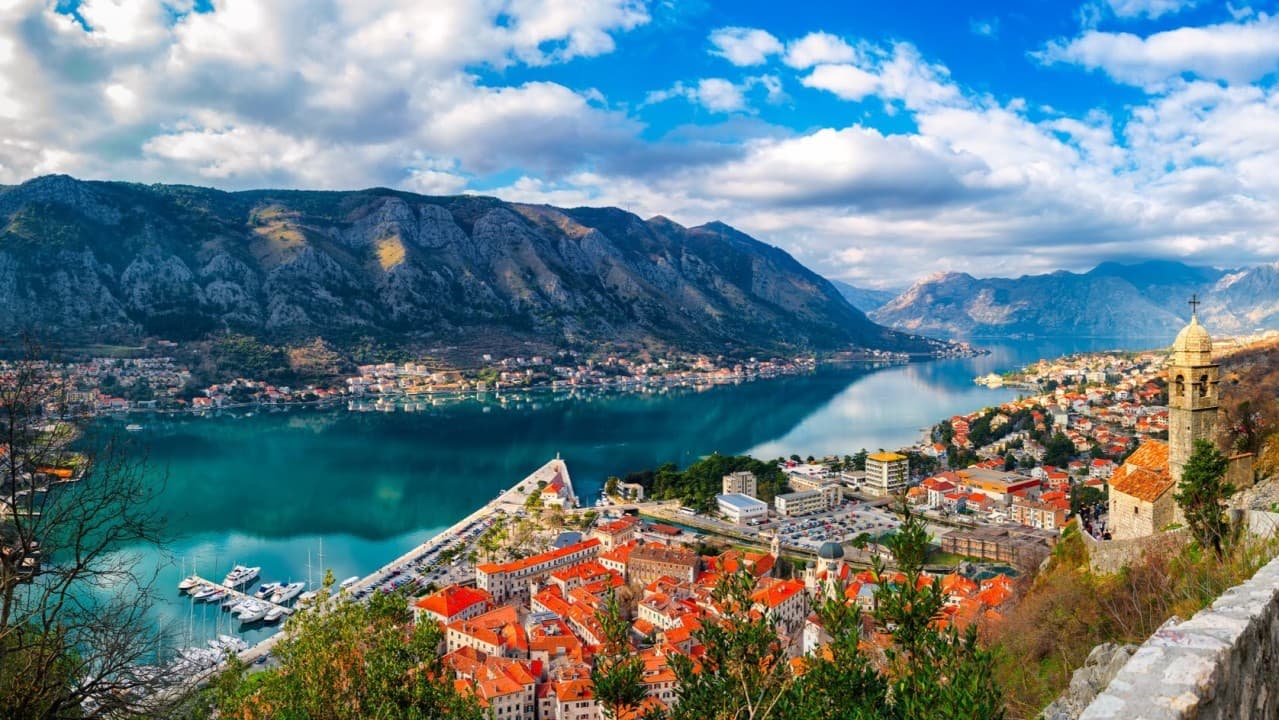
The Black Mountain
Exploring the rugged terrain of Montenegro.
The Black Mountain
Exploring the rugged terrain of Montenegro.
I hadn't planned Montenegro far in advance. In fact, I booked the tour just the day before. We were looking for what else to do, and when I saw the opportunity to cross into another former Yugoslav republic, I jumped at it. Each stop on this trip has been a chance to understand not just cities, but countries shaped by Yugoslavia's legacy. Here was another chance to learn how one more nation had carried its history — this time, Montenegro's experience.
I had always puzzled over its name. Croatia, Serbia, Bosnia and Herzegovina — all Slavic names in Slavic lands — and then, suddenly, "Montenegro." An Italian title meaning Black Mountain. Why would a Slavic country carry an Italian name?
Now, traveling along the coastline and walking the streets of Perast and Kotor, I begin to see why. The name came from Venetian sailors who saw the dark, forested mountains rising over the Adriatic. From the sea, it looked like one giant "black mountain." Locals called it Crna Gora — the same meaning in their own language — but in European maps and treaties, the Italian name endured. The dark canopy wasn't just any forest. It was formed by Italian cypress trees, their tall, slender silhouettes crowding the ridges and giving the mountains their near-black appearance. As we drove, I took photos of those cypress groves, realizing they may be the truest image for Montenegro itself: stark, resilient, and unmistakable in their presence.
History in Contrast
Montenegro's story is not the same as its neighbors. Bosnia and Herzegovina absorbed layers of Ottoman, Austro-Hungarian, and Yugoslav influence. Croatia leaned toward Catholic Europe, fighting a bloody war for independence in the 1990s. Montenegro survived differently. Its mountains shielded it from full Ottoman conquest, and its people organized into fiercely independent tribes. Unity was fragile, and survival required leaders who could rise above clan rivalries.
For over two centuries, that role fell to the "Prince-Bishops" of Cetinje — known as vladikas — Orthodox clerics who held both spiritual and political authority. Because they were celibate, they had no heirs and stood above the rivalries of the clans, which made them trusted mediators as well as defenders. They ruled from the Cetinje Monastery, a stone complex in a mountain valley about eight miles inland from the Bay of Kotor as the crow flies, yet protected by the rugged switchbacks of Mount Lovćen — the very peak that gave Montenegro its name. It was more than a monastery. It was the seat of power — church, fortress, and parliament all in one. Here the vladikas presided in cassock and rifle, leading their people in both prayer and battle.
Historians note that this system lasted from 1516 until 1852 — more than three centuries. The vladikas were not immune to ego or ambition. History is filled with "men of God" who abused their authority, and the fusion of priest and warrior could easily have turned destructive. What is striking is not that the vladikas were flawless, but that the system endured. The tribes were willing to entrust power to them, and in turn the vladikas provided a kind of legitimacy and unity the clans could not sustain on their own. It was a mutually beneficial relationship — fragile, perhaps, but remarkably durable.
The vladikas' influence rested on a paradox: they led precisely because they stood outside the very rivalries that divided their people. Sometimes, the most effective leadership comes from a voice perceived as neutral — one not bound to clan, faction, or personal gain. In modern organizations, external consultants often play a similar role.
Along the coast, other influences left their mark. Venetian strongholds dotted the Bay of Kotor, and some traditions point to medieval Knights Templar holdings near coastal towns. Whether by Templar, Venetian, or later Ottoman hands, these fortresses and churches remind us that Montenegro's narrow strip of coast was always contested, while its interior mountains remained defiantly free.
In the early 20th century, Montenegro was briefly recognized as an independent kingdom. But that independence was cut short in 1918. With its king in exile and its land devastated by World War I, Montenegro was absorbed into the new Kingdom of Serbs, Croats, and Slovenes — later known as Yugoslavia. Some Montenegrins welcomed the union as kinship with Serbia, while others saw it as annexation. Either way, Montenegro lost its sovereignty and would not see it again for nearly ninety years.
When Yugoslavia unraveled in the 1990s, Croatia fought a brutal war for independence. Bosnia and Herzegovina endured a still more painful conflict, leaving scars visible to this day. Montenegro chose a different path. It waited, and in 2006 became the final piece of Yugoslavia to separate — not through bloodshed, but through a referendum. By ballots, not bullets, Montenegrins reclaimed their independence. Unlike Croatia and Bosnia and Herzegovina, Montenegro faced no war because Serbia's leaders viewed Montenegrins more as kin than rivals, the country's small size posed little strategic threat, and by 2006 Milošević was gone, leaving Serbia too weakened and isolated to fight.
Cities that Tell the Story: Perast and Kotor
If you want to understand Montenegro, look to its cities. Perast and Kotor capture in stone what leadership and survival meant on this stretch of the Adriatic coast.
Perast is a quiet coastal town, once thriving under Venetian rule. Its story is a reminder of how smaller communities survived by aligning with larger powers. The town was also home to a renowned maritime academy — sometimes called the "Oxford of the Seas" — which trained generations of captains who served not only Venice but fleets across Europe. Perast's legacy shows that even a small town can punch above its weight when it invests in knowledge and skill.
Its most famous landmark is Our Lady of the Rocks, a man-made island in the Bay of Kotor. The legend goes that in 1452, two local sailors found an icon of the Virgin Mary on a rock in the bay. Believing it to be a divine sign, the townspeople vowed to honor her by creating an island at that very spot. Each time sailors returned safely from a voyage, they laid a stone into the water. Soldiers departing for war added stones too, asking for protection before they left. Over centuries, those offerings accumulated into a foundation strong enough to build both an island and a church. To this day, the tradition continues each July 22 with the festival of Fašinada, when locals still row out to drop rocks into the sea.
The island's story shows how shared rituals and myths create culture. A single legend became a collective ritual. The ritual became a shrine. And the shrine became a symbol of unity — proof that even fragile beginnings can grow into something enduring when a community contributes, stone by stone.
Kotor, by contrast, tells a story of defense and endurance. Surrounded by steep walls that climb the mountainside, its old town was a fortress against Ottomans, pirates, and rival empires. Walking its narrow lanes, you feel the pressure of centuries when survival depended on vigilance. Leaders here didn't have the luxury of complacency — their role was to prepare, protect, and keep unity in the face of constant threat.
The walls of Kotor are not just impressive — they are among the longest defensive walls in the world. Stretching 4.5 kilometers up the mountain of St. John, they form a stone ribbon reminiscent of the Great Wall of China. Just the day before, we had climbed the walls of Ston in Croatia, another entry in this rare club of top-five longest surviving defensive walls (alongside the Great Wall, India's Kumbhalgarh Fort, and others). Both Ston and Kotor show how small states invested massively in defense, understanding that vigilance was their only hope of survival.
Vigilance, and protecting their people, was most important. One of the roles of leaders today — often overlooked — is how they protect the dignity of their workforce. Businesses, especially during economic downturns, must sometimes make hard decisions. But there is a world of difference between leaders who treat employees as expendable and those who treat them with dignity. Too often, the stories that make headlines are the inhumane ones — like layoffs announced by email with no personal conversation.
What rarely makes the news are companies that choose a better way. Airbnb, for example, was praised in 2020 for handling COVID-19 layoffs with clarity, compassion, and extended support for employees. Southwest Airlines has long prioritized transparency and voluntary options during downturns. And Cisco has emphasized redeployment over blanket cuts. These approaches may not be sensational, but they show something greater: vigilance not only for the business, but for the dignity of the people inside it.
Closing Takeaway
Three leadership lessons stood out to me from Montenegro's story:
1. Neutral voices build trust. The vladikas led precisely because they stood outside clan rivalries. In organizations today, consultants and advisors can serve a similar role — surfacing truths others may fear to voice, provided they remain truly neutral. Psychological safety only works when it is practiced from both top down and bottom up.
2. Protecting people sustains resilience. Kotor's walls were built to safeguard the city from constant threats. In modern times, the equivalent is how leaders protect the dignity of their people — especially in hard moments like layoffs. Vigilance for the business must never come at the expense of humanity.
3. Patience can be power. While Croatia and Bosnia and Herzegovina fought brutal wars, Montenegro waited. By 2006, it secured independence not with bullets, but with ballots. Sometimes the boldest choice is restraint until the moment for peaceful change arrives. In today's fast-paced world — where technology accelerates under Moore's Law — leaders also need discernment: knowing where speed is essential, and where slow, steady persistence will win the day. As Daniel Kahneman framed it, wise leadership requires both System 1 (fast) and System 2 (slow) thinking.
Every leader must one day stand before their own "black mountain" — a challenge that feels overwhelming. Montenegro's story reminds us that such mountains are not conquered by size or strength, but by resilience, patience, and the quiet dignity of knowing who you are.