
The Fragile Flame of Mozart
Brilliance alone cannot sustain without stewardship.
The Fragile Flame of Mozart
Brilliance alone cannot sustain without stewardship.
In my last article, I wrote about Beethoven's story of struggle and transcendence. Today, we turn to Wolfgang Amadeus Mozart.
He holds a special place in my own musical journey. I've had the privilege of singing lead roles in his operas — Tamino in The Magic Flute (Die Zauberflöte), Don Basilio in The Marriage of Figaro (Le Nozze di Figaro), and Ferrando in Così fan tutte. Working on these roles meant living inside his music: duets, quartets, ensemble pieces, and soaring arias. I can still remember the joy of rehearsals, singing those melodies again and again — and then the moment when the orchestra joined in. Sublime doesn't even begin to describe it.
I've also conducted choirs in his profoundly moving motet Ave verum corpus (K. 618), a work of breathtaking simplicity and depth. His music has found its way into the world's imagination in countless forms. Even cinema has leaned on its beauty — think of the Oscar-winning film Out of Africa, where the Adagio from Mozart's Clarinet Concerto in A major (K. 622) became a haunting soundtrack to Meryl Streep and Robert Redford's story.
We know Mozart's music. It has endured through centuries — sublime, universal, timeless. To hear his music while visiting the halls where he once performed is like stepping into the studio of a master whose craft has shaped your own life.
Mozart's Vienna
Walking through Vienna today, it's hard not to feel his presence. On Domgasse 5, Mozart's preserved apartment is a reminder of his most productive years. Here, he wrote The Marriage of Figaro — a daring opera that poked fun at aristocracy, premiered in a city full of aristocrats.
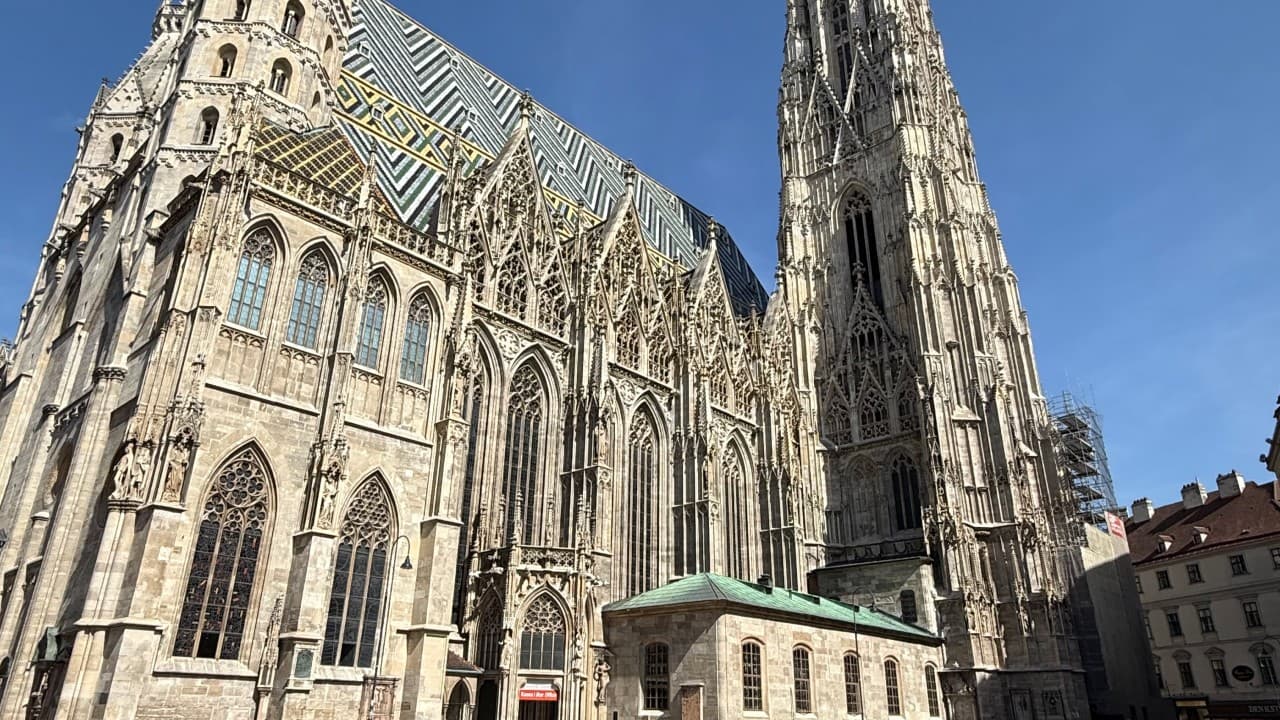
Just steps away stands St. Stephen's Cathedral — Vienna's Gothic heart and spiritual anchor — where in 1782 Mozart married Constanze Weber. Only nine years later, in December 1791, a small service for his funeral was held there. He was just 35 years old.
Not far away rises the Vienna State Opera, inaugurated in 1869 under Emperor Franz Joseph with a performance of Mozart's Don Giovanni. The Opera House was later bombed in WWII and left in ruins. Rebuilt in the 1950s, it reopened with Beethoven's Fidelio. It's a reminder that even institutions built for greatness must be rebuilt when crisis strikes.
Vienna in the late 18th century was the music capital of Europe, overflowing with talent and competition. Christoph Gluck was reshaping opera. Antonio Salieri, court composer to Emperor Joseph II, held powerful sway. Mozart, though dazzling, was not always the favored son. The Marriage of Figaro had modest success in Vienna with only nine performances (although in Prague it was received with tremendous acclaim). Even in his prime, Mozart wrestled with uneven reception and financial insecurity.
And yet, what a blaze he was. By the age of five, Mozart was already composing and performing for European courts. As a child prodigy, he astonished audiences across the continent, playing the harpsichord blindfolded, improvising fugues on the spot, and dazzling royalty with his effortless command of music. Even as an adult, he loved to showcase his virtuosity in Vienna's salons, improvising endlessly to prove his genius. The elder composer Joseph Haydn — one of the most respected voices of the age — famously declared:
""Posterity will not see such a talent again in 100 years."
Mozart's life was a flame that burned at full blaze — dazzling, prolific, intoxicating. But brilliance alone is not enough. In leadership, as in life, talent opens doors, but only character keeps them open. Without discipline, even the brightest flame cannot sustain.
The Dark Side of the Flame
For a time, Mozart was the most handsomely paid freelancer in Vienna. Audiences adored him, commissions poured in, and he earned enough to live comfortably. By most measures, he had what every young composer dreamed of: income, reputation, and opportunity.
And yet, even in his own words, we glimpse a restless hunger. In 1777, at just 21 years old, Mozart wrote to his father Leopold with striking bluntness:
""My wish is to obtain fame and money."
It's a confession both raw and revealing. He longed for security, independence, and recognition — but he never found equilibrium. For today's leaders, the same danger lurks. With a promotion into a new title, leaders and managers may become intoxicated by authority. I've seen it happen: yesterday's peers suddenly treat them with deference, and it's tempting to believe the admiration is about them as a person, rather than the role they occupy. That illusion feeds ego instead of humility — the very trap Eckhart Tolle describes when he wrote:
""Most people you meet want to enhance their identity — the mental image of who they are — through association with you. They themselves may not know that they are not interested in you at all, but only in strengthening their ultimately fictitious sense of self."
Mozart lived in that illusion. Despite his earnings, he constantly undermined his own success. He squandered money on lavish clothes, nights of illegal gambling, and the costly game of appearances in aristocratic Vienna. His letters reveal repeated pleas for loans and extensions, as creditors pressed harder. It wasn't poverty that undid him. It was his choices — the same danger leaders face when brilliance is squandered by impulse. He had the goose that laid golden eggs, but he never took care of the goose.
Leaders, too, can fall into this trap — chasing prestige while neglecting the daily stewardship that truly sustains influence. It isn't just prestige. Leaders can become consumed by externals of every kind: appeasing shareholders, managing media optics, pursuing the next acquisition, or cultivating high-profile networks. All of these can feel urgent and important. But when leaders outsource or neglect the daily operations and relationships that give life to their culture, they risk hollowing out the very foundation of their influence.
Competition and Legacy
Competition only heightened the pressure. While touring Mozart's apartment, I learned of a commissioned contest in 1786 where Mozart was pitted against court composer Antonio Salieri to set the same Italian text to music. Salieri's version won — a reminder to Mozart that acclaim was never guaranteed. Rivalries were fierce, and the demand to stay at the top was unrelenting. Leadership is much the same: competition is constant, and the applause of the moment is never secure. Even the most naturally gifted cannot simply rely on talent — resilience, discipline, and clarity are what sustain over time.
Salieri may have won that contest, but how many of us can hum one of his melodies today? His fame burned brightly in the moment but left little trace. Mozart, though he could not have known it then, left a legacy that far outlived his short and troubled life. And here lies the ultimate lesson: legacy is not measured in contests won, but in contributions that endure.
Of course, leaders today want to win in the marketplace — to gain market share, drive growth, and raise company valuations. But the narrow pursuit of these victories can quickly turn shallow if they come at the expense of those who make them possible. Legacy is never built by numbers alone. It is sustained by the care, alignment, and consideration leaders show to the people who carry the vision forward.
Closing Takeaway
Mozart's story reminds us that brilliance can inspire, but brilliance alone cannot sustain. A flame that burns too brightly, too fast, will not last the night. The same is true of leadership. Culture isn't transformed by grand gestures or fleeting recognition — it is built in the quiet consistency of leaders who show up, who listen, who let people feel seen.
Mozart's notes still echo through Vienna's concert halls, but his life warns us: genius without stewardship fades quickly. Leaders who want their culture to endure must do more than dazzle — they must sustain it through daily attention, consistent presence, and genuine care for their people. Just as Vienna rebuilt its Opera from ashes, enduring cultures are built not on fireworks or grand gestures of big events meant to make up for leadership neglect, but on the steady sparks of presence and care.