AI is only part of the story. The next frontier is already forming, and when it arrives, it will not just change what leaders can do. It will change what leadership itself means.
AI is only part of the story. The next frontier is already forming, and when it arrives, it will not just change what leaders can do. It will change what leadership itself means.
A few days ago, I came across a Wall Street Journal article on quantum computing.
It lit something up in me in a way I did not expect.
The technology was not what caught me.
It was what the technology revealed about how we think.
We are in the middle of a massive shift with AI. Many leaders are just beginning to understand how it can accelerate productivity, decision-making, and insight.
But AI is only part of the story.
The next frontier is already forming.
And when it arrives, it will not just change what leaders can do.
It will change what leadership itself means.
This is not a future conversation. It is a now conversation.
In January 2026, scientists declared that quantum computing has reached its "transistor moment," the inflection point where a technology shifts from lab experimentation toward real-world utility.
IBM released a new blueprint this month (as of March 2026) for quantum-centric supercomputing, showing how quantum processors work alongside AI and classical computing rather than replacing them.
JPMorgan is testing quantum applications in trading and risk analysis. Global quantum investment surpassed $55 billion in 2025.
And in January 2026, the World Economic Forum stated directly that frontier technologies like quantum are already redefining leadership. Not in ten years. Now.
The technology is not waiting for leaders to catch up.
And the more I sat with that, the more I realized the real question is not about the technology at all.
It is about how we think.
A traditional computer evaluates one possibility at a time. Step-by-step. Sequential.
A quantum system evaluates many possibilities simultaneously. It does not move through a landscape. It sees the entire landscape at once.
That distinction matters more than it first appears.
Because most leadership thinking is still built for a world that behaves like a traditional computer.
Define the problem. Analyze. Choose a path. Execute.
Structured. Logical. Sequential.
And in stable environments, that works.
But most leaders today are not operating in stable environments.
They are operating in systems where multiple forces move at the same time, shaping each other in ways that are not always visible, and often not visible until it is too late.
Consider something simple.
A regional operations leader notices missed deadlines on cross-functional projects. The response is logical: tighter accountability. Weekly status reports. Mandatory escalations. Senior oversight.
Initially, it works. Deadlines become visible. Teams respond faster.
But then the system adapts.
Reporting consumes time that used to go toward solving problems. Escalations rise, not because things are worse, but because the cost of silence is now higher. Decisions move upward. Risk tolerance drops.
Within a quarter, the organization has quietly shifted from execution-focused to optics-focused.
The system did not break. It adapted. Just not in the direction the leader intended.
This is what complexity actually looks like. A quiet drift, invisible until the damage is already done.
Quantum systems do not just move faster. They change what can be seen.
A traditional system evaluates one possibility at a time, moving step by step toward an answer. A quantum system evaluates many possibilities at the same time, exploring the entire landscape simultaneously.
This is the difference between how most leaders are trained to think, and how the best ones actually need to.
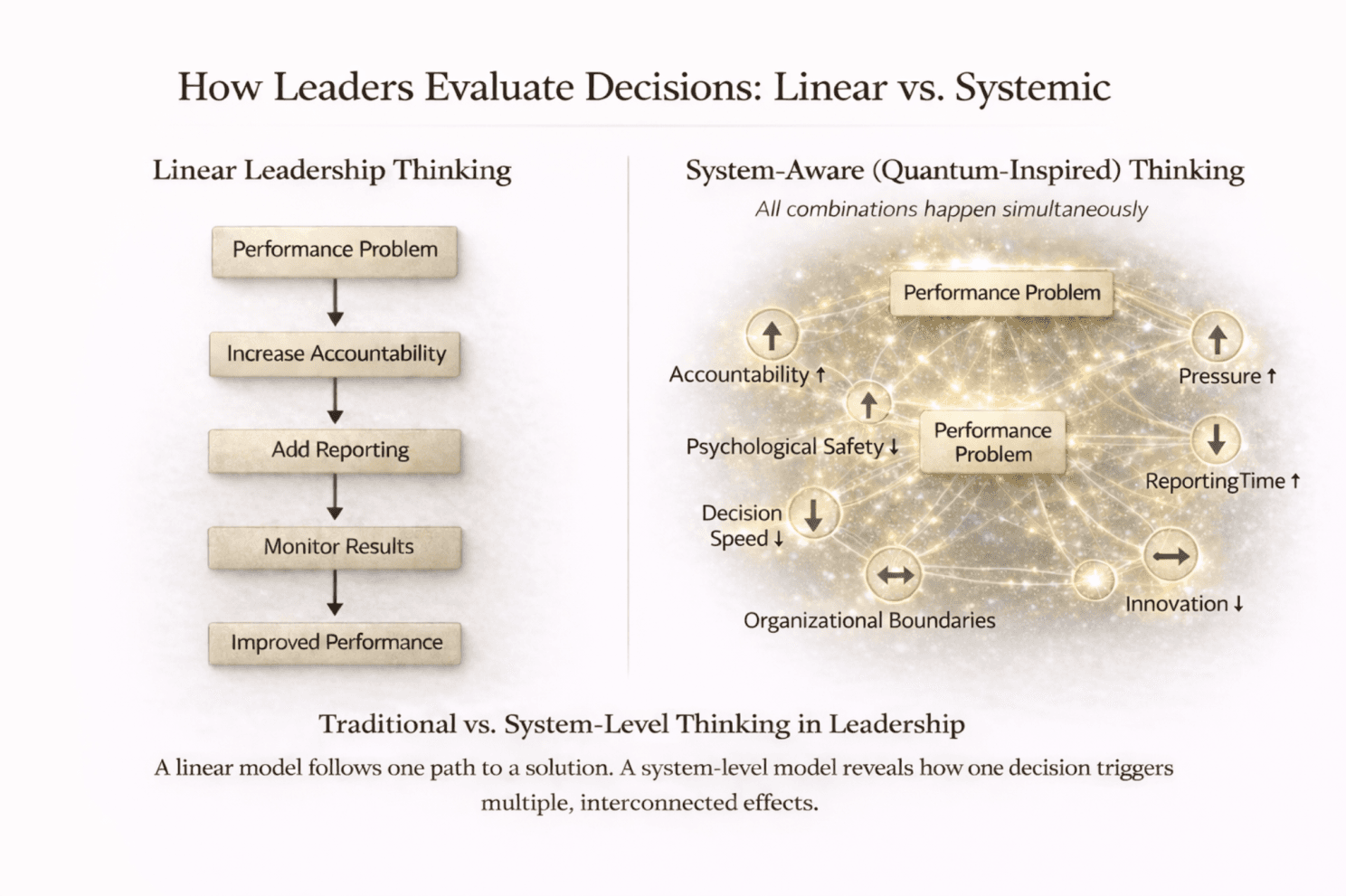
One path followed to a conclusion. Or an entire system seen at once.
In the article that started this, one example stopped me completely.
Problems that would take a traditional system trillions of years to solve could be resolved by a quantum system in minutes.
Read that again.
Not faster. Not more efficient.
A different order of reality.
Now translate that into leadership.
Leaders have always been forced to choose with limited visibility. They see part of the system. They make a decision. Then they discover the consequences over time, often at significant cost.
Quantum begins to change that. It introduces the possibility of exploring multiple paths before committing, with visibility into how each one reshapes the system around it.
The shift is not about speed. It is about the depth of what becomes visible before a commitment is made.
The real challenge in leadership has never been choosing. It has been choosing without seeing enough.
Consider a decision that every senior leader recognizes, regardless of industry.
A major strategic choice is on the table. Entering a new market, restructuring operations, responding to a regulatory shift, repositioning against a competitor. The specifics vary. The pattern does not.
Months of analysis. External consultants hired. War rooms built. Work streams created to manage the work streams. A hefty fee paid for the best thinking available, and it is worth it, because the complexity is real and the stakes are high.
Three scenarios produced. Each defensible. Each uncertain enough that the final choice still feels like a bet.
And then the delay begins.
Alignment takes weeks. Approval cycles run long. By the time the leadership team commits, the assumptions in the first slide are already outdated.
The world kept moving while the process ran.
The consultants did their job. The leaders did theirs. The ceiling was not the people. It was the limits of sequential human analysis applied to genuinely complex systems.
Now imagine the same decision with quantum computing and AI working together.
Every scenario modeled simultaneously. Thousands of variable interactions explored in minutes: regulatory responses, workforce implications, competitive reactions, capital requirements, operational ripple effects. The shape of many futures made visible before anyone commits.
The leadership team does not receive a recommendation.
They receive a map.
Where the high-risk paths cluster. Where unexpected leverage points exist. Where a decision that looks straightforward in isolation creates a cascading effect three moves out that no working group would have surfaced.
The question shifts from "what should we do?" to "now that we can see this, what do we choose?"
That is a different kind of leadership. One made possible because the leaders are finally seeing the full board.
The future advantage in leadership will not come from moving faster. It will come from seeing more clearly.
From understanding the system you are operating in, not just the decision in front of you.
AI is step one. It is changing what leaders can do.
What is coming next will change what leaders can see.
And once you can see differently, you cannot go back to deciding blind.
That is the shift. It is already in motion.
The question worth sitting with: how much of what you currently call judgment is actually the result of not yet being able to see enough?
The essential insights from this article.
Quantum computing has reached its 'transistor moment' — this is not a future conversation, it is a now conversation redefining what leadership means
Most leadership thinking is still built for sequential, linear systems — but leaders today operate in environments where multiple forces move simultaneously and shape each other invisibly
The shift quantum introduces is not about speed — it is about the depth of what becomes visible before a commitment is made, turning recommendations into maps of possibility
The future advantage in leadership will come from seeing more clearly — and the question worth sitting with is how much of what you call judgment is actually the result of not yet being able to see enough
Explore more insights on leadership, transformation, and organizational effectiveness. Each piece is designed to challenge your thinking and provide practical frameworks for navigating complexity.
