

Paris Edition - Part 4: What Do Frédéric Chopin and Jim Morrison Have in Common?
At Père Lachaise Cemetery, two musicians from different centuries rest within walking distance of one another. Their contrasting relationships to intensity offer a leadership lesson that does not need to be shouted to be heard.
Paris Edition - Part 4: What Do Frédéric Chopin and Jim Morrison Have in Common?
At Père Lachaise Cemetery, two musicians from different centuries rest within walking distance of one another. Their contrasting relationships to intensity offer a leadership lesson that does not need to be shouted to be heard.
At first glance, almost nothing.
Different centuries.
Different musical languages.
Different relationships to fame, discipline, and excess.
And yet, while visiting Paris, I discovered that they are buried within walking distance of one another at Père Lachaise Cemetery, tucked into the Père-Lachaise / Gambetta neighborhood of the 20th arrondissement, a quiet corner of the city where very different lives now share the same ground.
That proximity invites a question that feels almost unavoidable.
What do these two musicians have in common?
The obvious answer is geography.
The more interesting answer has something to do with leadership.
An Unexpected Abundance
I went to Père Lachaise Cemetery looking for Frédéric Chopin and Jim Morrison, the lead singer of The Doors.
I ended up with far more than I bargained for.
What I expected to be a brief visit turned into nearly two hours of wandering.
Along the way, we encountered the graves of composers, writers, and artists whose work has shaped my inner world for decades.
Gioachino Rossini.
Georges Bizet.
Vincenzo Bellini.
Clément Philibert Leo Delibes.
Francis Poulenc.
Oscar Wilde.
Molière.
Marcel Proust.
Even Maria Callas used to be buried here.
These were not just famous names.
These were voices I had sung. Words I had read. Works that had already lived inside me.
Walking among them felt less like visiting a cemetery and more like standing inside a living library of human expression.
It was a gift.
And yet, as rich as that experience was, I kept coming back to the same two graves.
Chopin and Morrison.
Jim Morrison's grave is roughly a four minute walk, about 280 meters, from Frédéric Chopin's tombstone.
Within the scale of this vast cemetery, that distance still felt surprisingly close.
Close enough to invite comparison.
A Personal Detour: Why Chopin Matters to Me
As a musician, I was always drawn to the Romantic era composers.
There was something about the emotional honesty of that period that resonated with me early on.
Rachmaninoff.
Schubert.
Schumann.
Liszt.
But Frédéric Chopin was always at the top of the list.
I was not technically adept enough to play some of his most demanding works.
But I found myself deeply at home in his more restrained, expressive pieces, the ones that did not shout, but spoke.
I spent countless hours with:
- Prelude in C minor, Op. 28 No. 20, sometimes nicknamed the "Funeral Prelude," a short piece, but heavy with chordal solemnity
- Prelude in A major, Op. 28 No. 7, my favorite. The melody carries a quiet, romantic tenderness that felt incredibly expressive
- And the ever popular Minute Waltz (Op. 64 No. 1), fun, fast, yet unmistakably Chopin underneath
Even then, what drew me to Chopin was not technical flash.
It was containment.
Emotion held carefully within form.
Intensity that did not need to announce itself.
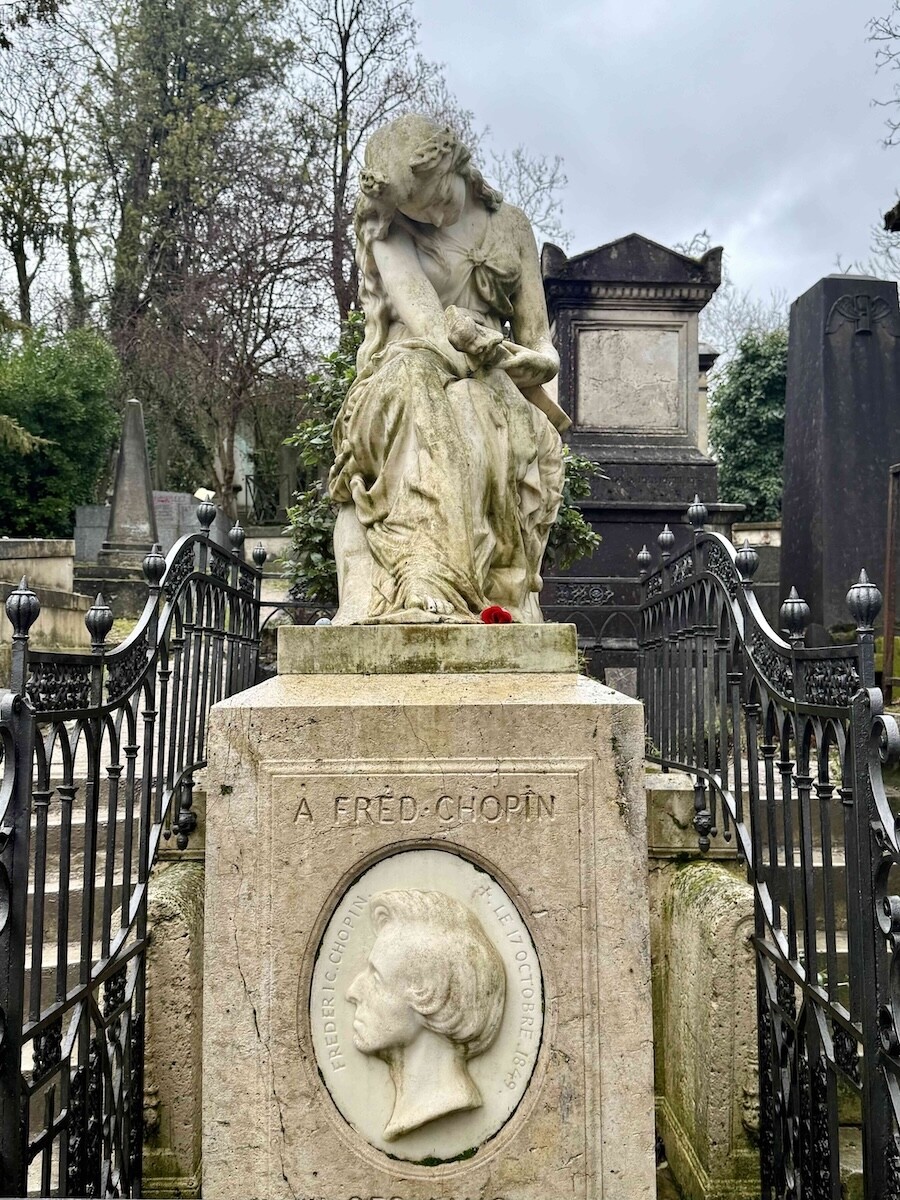
So visiting his grave did not feel like sightseeing.
It felt like paying homage to a voice that had shaped my inner world long before I had language for why.
That Jim Morrison was buried nearby felt almost incidental at first.
A curiosity.
Standing there, it became something else entirely.
Two Musicians. Two Relationships to Fire.
Both Chopin and Morrison were profoundly expressive.
Both gave voice to something raw, human, and deeply felt.
Both refused to dilute their truth to fit convention.
But they carried their fire very differently.
Chopin: Fire Held by Form
Chopin led quietly.
He avoided public performance whenever possible.
He worked obsessively within form.
Born near Warsaw in Poland, Chopin carried a deeply interior world shaped by Polish musical traditions.
Physically fragile and emotionally sensitive, he found large concert halls draining and preferred salons and small rooms where nuance could be heard and felt.
He guarded his energy.
He revised relentlessly.
He believed emotional expression required structure in order to endure.
This is a form of leadership where influence comes from consistency between inner discipline and outward behavior, not from being highly visible, charismatic, or performative.
Chopin did not rely on presence in the room to create impact.
His influence came from mastery, restraint, and sustained quality over time.
Morrison: Fire Unleashed Through Presence
Jim Morrison grew up in a very different world.
The son of a U.S. Navy admiral, Morrison was raised in a highly structured, disciplined, and emotionally restrained environment.
Frequent relocations.
Rigid expectations.
Little tolerance for emotional expression.
By his own accounts, he felt unseen and disconnected early in life.
Music, poetry, and philosophy became his outlet.
He immersed himself in literature, mythology, and existential thought, drawn to voices that questioned authority and exposed the underside of human experience.
Where Chopin internalized intensity and refined it, Morrison externalized it and challenged it.
As lead singer of The Doors, Morrison led through presence, provocation, and charisma.
The stage amplified his intensity rather than regulating it.
He gave voice to what was repressed.
He disrupted cultural norms.
He forced confrontation, both in himself and in his audience.
Two Graves. Two Kinds of Legacy.
The contrast did not stop at biography.
It continued at the graves themselves.
Chopin's grave sits quietly along a lined row.
Isolated.
Undisturbed.
Few visitors.
And yet, Chopin's music lives everywhere.
His works remain foundational in the classical repertoire.
Any pianist who seriously studies the instrument eventually passes through Chopin.
His influence is institutional, embedded, and enduring.
It is carried forward through discipline, study, and tradition, not pilgrimage.
The scene at Jim Morrison's grave could not have been more different.
Reaching it meant navigating a small crowd.
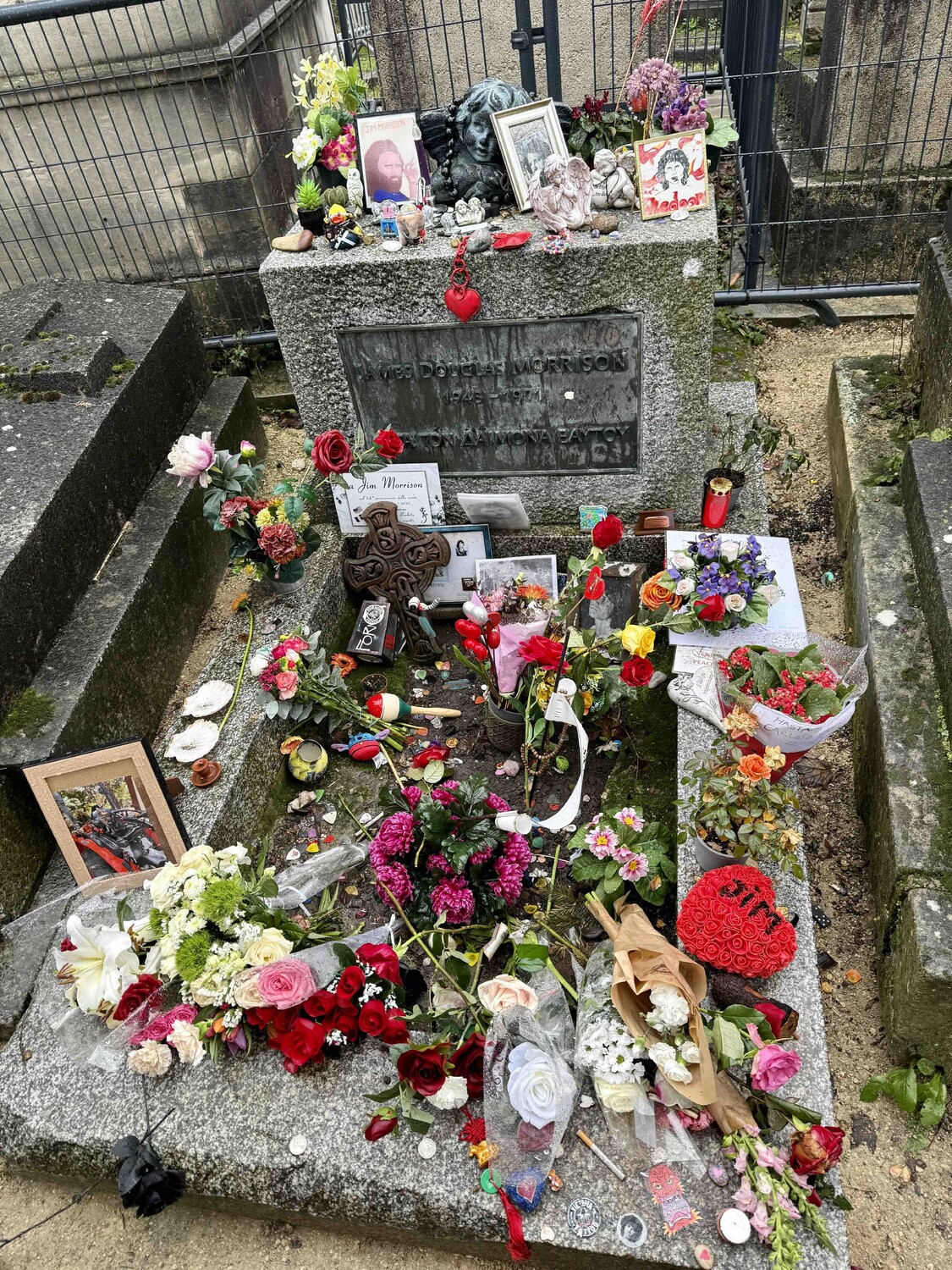
I found myself briefly competing with another couple, likely in their mid-50s, to stand in front for a photo.
Then two young French men, barely in their twenties, stepped forward.
This was clearly not the generation that grew up with Morrison's music.
And yet, there they were.
Standing quietly.
Whispering to one another in French.
Lingering.
Morrison's tomb was covered with mementos and memorabilia.
Tokens.
Messages.
Traces of devotion.
What struck me was not nostalgia.
It was continuity.
Morrison's influence remains visceral and relational.
People do not study him so much as feel him.
Two musicians.
Two graves.
Two forms of influence still alive today.
One is preserved through formal mastery and tradition.
The other through emotional identification and cultural memory.
"Organizations face the same choice in legacy: whether what endures is a system that outlives its founders, or a personality that must be continually remembered to stay alive.
A Final Contrast Worth Naming
Both men died young.
That matters.
Chopin died at age 39, which is young by any standard.
But unlike Morrison, his early death was not the result of excess or self-destruction.
It was the consequence of lifelong health limitations that he actively managed rather than ignored.
He conserved energy.
He avoided environments that overwhelmed him.
He shaped his work to fit the vessel he had.
Jim Morrison died at age 27.
His death in Paris was officially attributed to heart failure, occurring in the context of heavy substance use, exhaustion, and a lifestyle marked by sustained excess.
Morrison did not organize his life around limits.
He routinely pushed past physical, emotional, and psychological boundaries, often treating intensity itself as a source of truth and authenticity.
The difference is not tragedy.
Both lives ended too soon.
The difference is how each related to intensity.
Chopin lived with limits he did not choose and adapted to them.
His discipline was not aesthetic.
It was adaptive.
His fire was contained enough to sustain creation over time.
Morrison resisted containment.
The same fire that fueled his presence and cultural impact also eroded stability, health, and resilience.
It burned fast.
Bright.
And without much regulation.
This is not a moral judgment.
It is a practical one.
"Fire can warm, illuminate, and endure when it is contained. Fire can also consume and destroy when it is not kept in check. Leadership works the same way.
The Leadership Question That Remains
Every leader carries intensity.
Drive.
Conviction.
The question is not whether you have it.
The question is whether you are shaping it, or whether it is quietly shaping you.
That question lingers here, in a cemetery where two very different musicians rest within walking distance of one another.
Two lives.
Two relationships to intensity.
And a leadership lesson that does not need to be shouted to be heard.