

India Edition - Part 1: Golconda Fort and What Systems Do Under Pressure
Strip away mission statements, values, and good intentions, and one question remains: What does your system produce on Tuesday?
India Edition - Part 1: Golconda Fort and What Systems Do Under Pressure
Strip away mission statements, values, and good intentions, and one question remains: What does your system produce on Tuesday?
Last month, I conducted leadership sessions in Pune and Hyderabad.
I've worked in India many times before. What I had not done was write explicitly about leadership through the lens of Indian history and the systems that allowed large, complex societies to function under sustained pressure.
This article marks the beginning of the Leadership Lessons Without Borders: India edition.
In Hyderabad, the contrast is immediate. Driving through the city, you pass modern glass office buildings with familiar U.S. brand names from banking, consulting, technology, and other major global industries. These are contemporary systems designed for speed, scale, and efficiency.
Rising above the city are the stone ruins of Golconda Fort.
Golconda was designed to function under pressure, not to make a statement.
A Brief Word on Golconda
Golconda Fort was originally constructed in the 12th century and significantly expanded in the 16th century under the Qutb Shahi dynasty, when Hyderabad emerged as a major center of political power, trade, and diamond commerce.
Its location was deliberate. The fort sits atop granite hills that provided natural defense, long-range visibility, and control over key trade routes across the Deccan plateau. At its height, Golconda housed the ruling Qutb Shahi leadership, senior administrators, military forces, and the infrastructure required to govern and defend the region under prolonged threat.
That's what makes it useful.
The Gate Tells You What the System Assumes
At the main gate, the design intent is clear.
The entrance is shielded by a thick, horseshoe-shaped stone wall built directly in front of the main gate. Rather than approaching the gate head-on, entry is forced through narrow side openings at the ends of the curved wall.
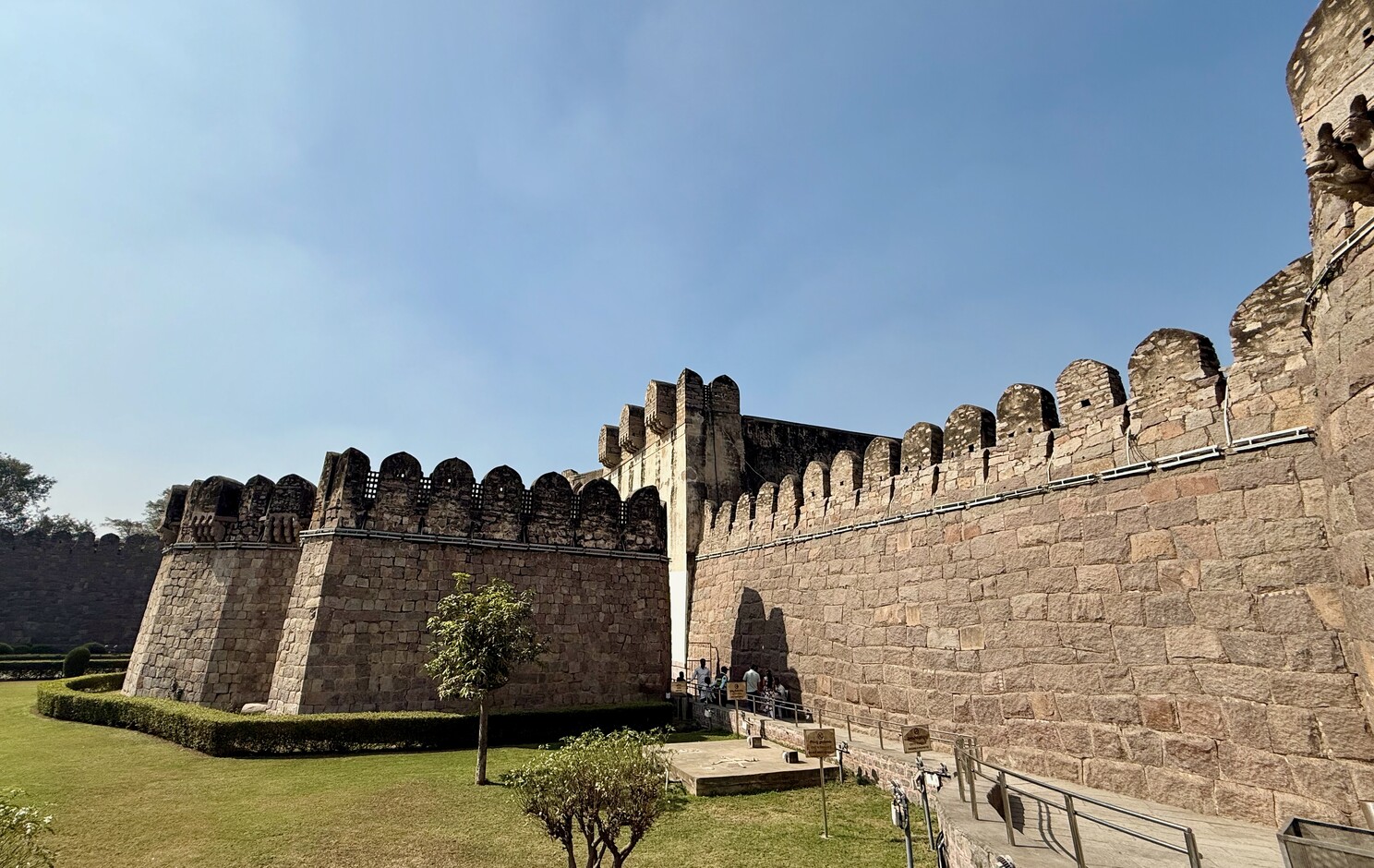
These passages funnel movement into a tight space between the horseshoe-shaped outer wall and the fort's main wall, slowing progress, limiting how many people can enter at once, and preventing any direct rush toward the gate.
This is not ornamental. It is functional.
From the outer gate to the citadel, there is no direct path. Access is slow, indirect, and deliberately exposed the entire way. The route covers nearly a kilometer and climbs roughly 100 to 120 meters in elevation, moving uphill through a sequence of narrow, turning passages.
That design created time and distance between the entry gate and the fort's inner stronghold.
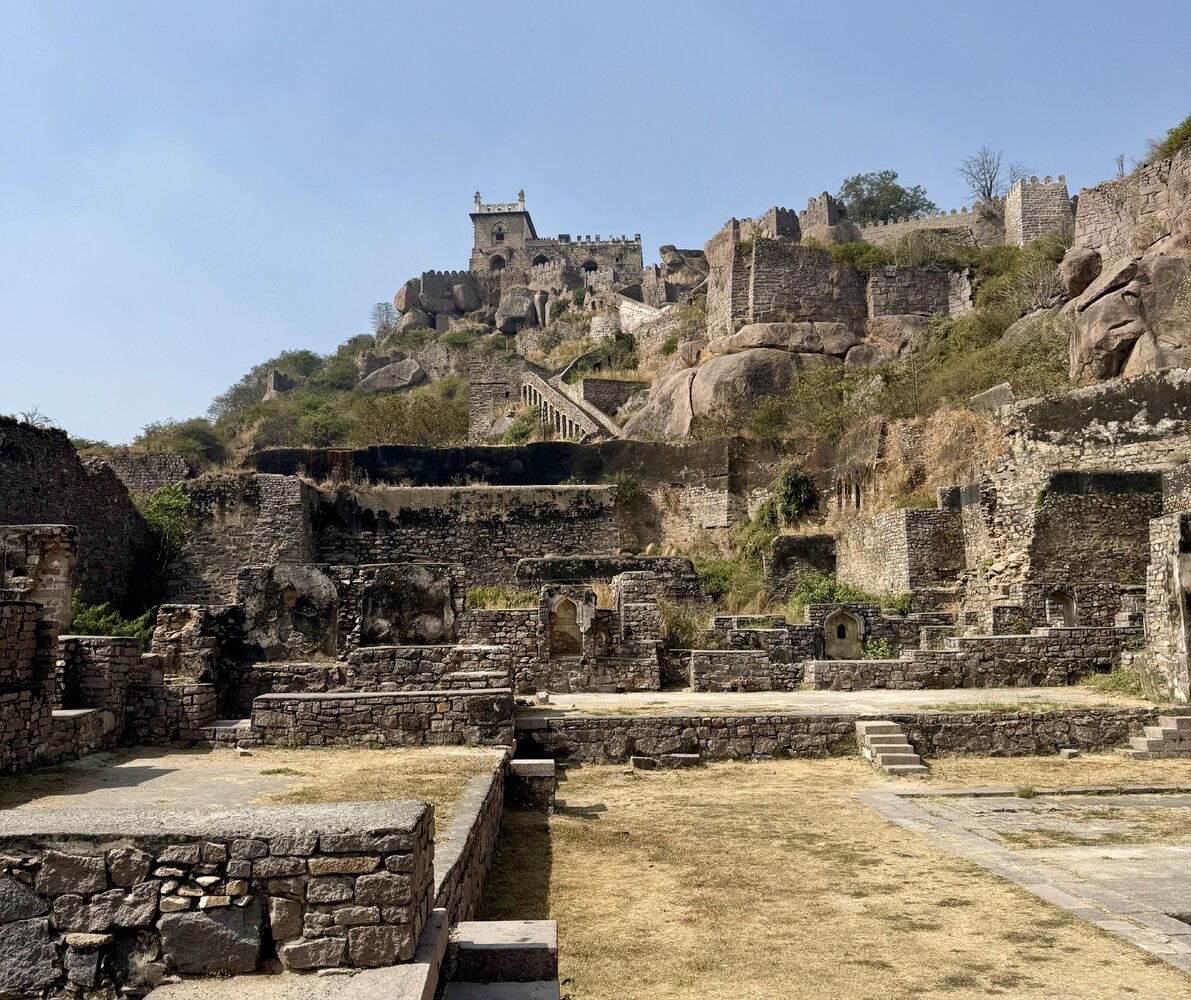
This was not about ceremony or hierarchy. It was a practical response to how systems behave when conditions deteriorate.
Golconda was designed with the expectation that leaders would not always be present, information would arrive incomplete, and decisions would be made under pressure. So access is slowed, movement is constrained, and the system continues to function even when coordination breaks down.
That's not a list of problems.
That's a normal Tuesday in most organizations.
The real question is:
"What does your system produce on Tuesday?
Signal Was Engineered, Not Assumed
One of Golconda's most practical features is its acoustic signaling system.
From the main gate, a single clap could be heard clearly at the citadel nearly a kilometer away, rising roughly 100 meters in elevation through a sequence of stone corridors and chambers.
During the tour, the guide clapped once at the gate. Standing beside him, I could hear the echo carry upward and inward through the fort.
That distance and elevation matter.
Sound didn't arrive by chance. It arrived because the path was engineered.
Leaders cannot act on what they do not hear. Golconda did not rely on escalation, interpretation, or courage to move information upward. It reduced friction in the signal itself.
But signal is only half the problem. What matters just as much is what is allowed to travel upward, and what is stopped long before it reaches the top.
Speed Was Directed, Not Left Unchecked
In many modern organizations, speed becomes the default response to pressure. Markets shift, expectations rise, timelines compress, and leaders rightly push for faster execution.
But in that push, speed often becomes undifferentiated.
Everything moves upward: information, decisions, problems, and responsibility that no one wants to own. As pressure increases, so does the volume.
What was meant to create momentum ends up flooding the top of the organization, where executive judgment should be focused and the most leveraged decisions belong.
I hear this frustration often from CEOs. They describe days spent acting as referee, parent, or judge, pulled into conversations their direct reports should be having directly with one another. They are asked to make decisions that are not the most leveraged for the organization, not because the decisions are complex, but because taking accountability for them feels exposing and politically risky lower in the organization.
Those decisions don't belong at the top.
They create clutter.
They pull attention away from the few choices that actually require executive judgment.
But partial accountability sits with the CEO as well.
When senior leaders repeatedly accept these escalations, they quietly train the organization to offload responsibility upward. And, if we're honest, there is often a subtle reward embedded in this pattern. Being needed feels like leadership. Being the final arbiter can feel like value.
Golconda is instructive here. It does not prevent action at lower levels of the system. Most movement and response happen away from authority. What it prevents is unnecessary movement upward.
Only the most consequential judgments are allowed to travel upward, and they do so clearly and quickly.
The system doesn't slow work down.
It routes only the most consequential judgments and tradeoffs to the top of the organization.
That distinction matters.
Why This Still Matters
Many modern organizations operate as if cooperation, availability, and reasonable behavior can be relied upon. Golconda was designed to function when delay, conflict, and pressure were expected.
That difference shows up when priorities collide, leaders are absent, incentives pull in different directions, bad news is uncomfortable, and time pressure increases.
Golconda was built for those conditions. Many organizations still are not.
That's why Golconda is still standing.
And why it still teaches.
A Closing Test
Strip away mission statements, values, and good intentions, and one question remains:
"What does your system produce on Tuesday? That answer tells you more about leadership than any slogan ever will.